“Nothing marks its location and few people know the secret, but beneath Plaza de la Cebada, stretching southward, lay the oldest cemetery ever documented in Madrid: the Islamic maqbara, which was the eternal resting place of Madrid’s Muslims from the 9th century until the early 16th century”.
Five hundred years after the disappearance and urbanization of that necropolis, beneath the houses between Toledo and Humilladero streets, many tombs still remain, their dwellers facing Mecca as they await the arrival of yaum al-qiyama: the Day of Resurrection.
On February 21, 1502, the Muslims of Madrid reached an agreement with the City Council regarding the conditions of their conversion to the Catholic faith, in compliance with the royal decree issued on the 14th of the same month. The Mudejar community of Madrid was the last surviving remnant of madinat Mayrit, the “small and prosperous city” on the northern frontier of al-Andalus mentioned, among others, by the renowned Ceutan geographer al-Idrisi in his Book of Roads and Kingdoms. It was a small community which, despite its limited numbers, enjoyed a good reputation and held a certain importance in the town due to its role in key sectors such as public works, blacksmithing, and carpentry. For this reason, Madrid’s Mudejars had managed, to a greater or lesser extent, to circumvent the measures imposed since the 13th century that sought to marginalize them—namely, segregation from Christian society through the obligation to live in a separate quarter, to wear distinctive signs, or the prohibition from practicing certain trades, among others. Tolerance, however, would not last forever.
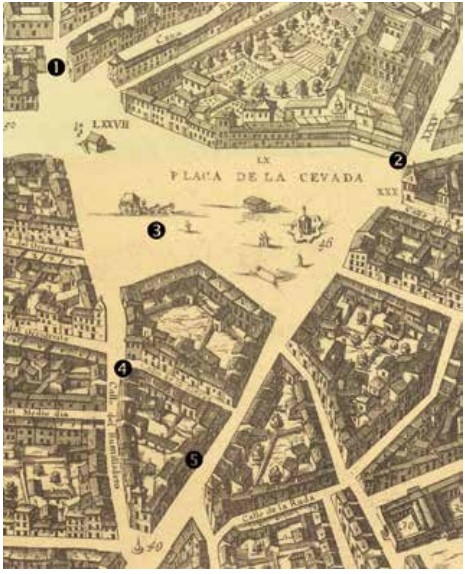
Plaza de la Cebada in Texeira’s map (1656). Marked on it are: the location of the Puerta de Moros (1); the Hospital de la Latina, which acquired part of the Muslim cemetery grounds (2); the current site of the Cebada market, where tombs were discovered in the late 20th century (3); Calle de la Sierpe, which was built over the “Moorish ossuary” (4); and the present-day number 68 of Calle Toledo, where the cemetery was archaeologically documented for the first time (5).
The Catholic Monarchs were determined to eradicate religious diversity in their realms. Thus, after the conquest of the Kingdom of Granada in January 1492—carried out under the pledge to respect the faith and customs of the Granadan Muslims (the famous capitulations, which were soon set aside)—came the decree of expulsion of the Jews in March of the same year. Shortly thereafter, the forced conversion of the “Moors” was ordered: first in the Kingdom of Granada (1501), then in Castile (1502), and finally in the Crown of Aragon (1525).
Faced with the impossibility of avoiding conversion, the aljama—the institution that formally represented the Mudejar community—reached an agreement with the City Council on the conditions for collectively embracing the mandatory religion. In addition to being exempted from paying taxes and from the jurisdiction of the Inquisition for ten years, the Mudejars requested and obtained from the Council, as recorded in the Book of Agreements, the preservation of the “ossuary that they have with its stones,” that is, the cemetery of their community. This was the place which—as we now know—had served as the eternal resting ground for Madrid’s Muslims from the 9th century until that moment in the early 16th century, making it possibly the oldest cemetery in Madrid.
The Islamic Cemetery
It used to be an open space outside the city walls, with trees and plants that made it a place for both contemplation and leisure, a spot for strolling and gathering. Canonical Islam considered it improper to excessively mark graves, and especially to inscribe the name of the deceased, so that social distinctions would not persist in death. However, social practice did not always follow these guidelines. Graves were typically marked with stones at the head and foot, and often also along the sides. Many of these stones were decorated with religious inscriptions or ornamental elements, and in general, they were later looted and reused when the traces of Muslims and Jews on the peninsula were deliberately erased.
The location of the necropolis, in the vicinity of Plaza de la Cebada, is well documented because Beatriz Galindo, nicknamed La Latina, began to exert pressure in October 1502 for the land on which the ossuary stood to be transferred to the hospital that bore her name, which, incidentally, had been built a few years earlier under the direction of a Mudejar master builder, Maestre Haçan. We do not know why the agreements between the Council and the aljama seem to have been rendered ineffective, at least with regard to the maintenance of the cemetery, and the gap in the Books of Agreements between 1504 and 1512 prevents us from knowing what vicissitudes the Muslim converts of Madrid had to face in their early years.
The fact is that the ossuary disappeared, swallowed by urban expansion, and “its stones,” that is, its tombstones, were reused in various constructions. By 1557 the area was already partially urbanized, as evidenced by a document concerning a property on Calle de la Sierpe, in which the owner acknowledges the tax imposed on it: “A plot and house located on the outskirts of this town, outside the Puerta de Moros, on what was the Moorish ossuary, bordering […] and with the street that was made through the said ossuary, subject to a tax of one real.” 1
The Muslim Burial
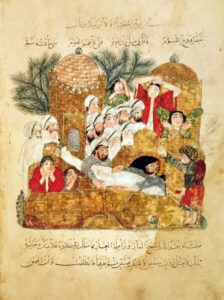
Muslim burial in a qubba, from al-Hariri’s Maqamat, illustrated by Yahya al-Wasiti (1237).
According to canonical ritual, which was gradually imposed, burial had to take place as soon as possible, generally within 24 hours after death. The body was carefully washed, perfumed, and shrouded in an odd number of clean cloths. Then it was carried to the cemetery on a bier or wooden boards, and once there, the attendees, lined up before the deceased, recited the funeral prayer. The body was interred without a coffin, with the face or the entire body turned toward Mecca. Ideally, the body was protected with planks or stone slabs so that the earth would not fall directly upon it.
The rediscovery of the cemetery took place, discreetly, in the late 1990s, when, according to archaeologist Manuel Retuerce, construction works at the Cebada market brought to light several burials that were quickly and quietly concealed—no doubt to avoid interfering with urban development plans. At the time, Retuerce wondered whether the cemetery belonged solely to the late medieval Mudejar population or if it could also be attributed to the Andalusi period.
The answer came in 2006, when 43 burials were found on the ground floor of number 68, Calle Toledo, beneath the pavement preparation level and construction debris. These burials were oriented toward the qibla, that is, the direction of Mecca, and dated from the 4th to the 15th centuries. Several of the remains were cut off by the property’s perimeter, meaning they continued beneath neighboring houses. This clearly suggested that the find was only a small section of a cemetery that might have extended from the vicinity of Plaza de la Cebada southwards, between present-day Calle Toledo and Calle del Humilladero.
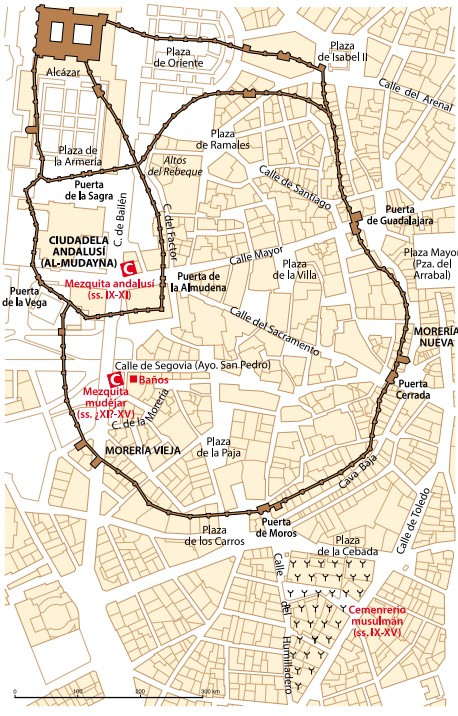
It was located just outside the Puerta de Moros—so named because it led to the Morería quarter through the medieval Christian wall—which is consistent with the Muslim tradition of placing cemeteries outside city walls, and contrasts with the Christian practice of the time, which typically buried the dead next to churches. One striking detail, given that the cemetery was already in use during the Andalusi period, is its distance from the almudayna, or walled enclosure of Islamic Madrid. This could be interpreted as further evidence of the existence of a large suburb between the cemetery and the fortified citadel—a suburb that would have shaped the later layout of the Christian wall.
Map of medieval Madrid showing the successive walled enclosures (Muslim and Christian) and the location of the cemetery.
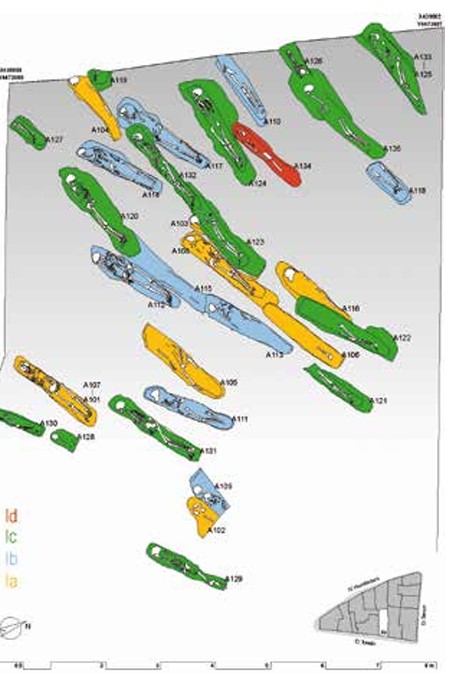
The bodies found at 68 Calle Toledo were discovered in narrow graves of varying depth, with their feet pointing east-northeast and their heads west-southwest, facing to their right—that is, toward the southeast, the direction of the qibla as required by Muslim funeral rites. However, the graves show differences that indicate an evolution in this ritual. According to the report by archaeologist José Ignacio Murillo2, in eight of the tombs, dated from the late 9th to the early 10th century, the bodies were in a supine position (lying on their backs) with only the head and hands oriented toward the qibla. In another ten tombs, of a later date (from the late 10th to the early 12th century), the bodies were arranged similarly, but remains of pine planks lining the vertical walls of the graves—and in some cases iron nails—were found. This may reflect the broader Islamic practice of preventing earth from falling directly onto the deceased. The grave walls were reinforced and covered with wood (in this case), stone slabs, or tiles, over which a small mound of earth could later be erected. This created a cavity that, in addition to facilitating the aerial decomposition of the corpse, allowed the deceased—according to tradition—after hearing the footsteps of their relatives recede, to receive the visit of the angels Nakir and Munkar for judgment. No remains of the wood covering the graves have been found, likely due to the leveling of the site or the natural decomposition of the material.
The later tombs (from the 12th to the 15th centuries) differ markedly from the earlier ones in several respects. First, the bodies are positioned on their right side in a lateral decubitus, and almost all graves are stepped. Both features indicate a shift from the tradicionist ritual of earlier periods to the Maliki rite, which eventually became dominant in al-Andalus. This rite prescribes that the entire body of the deceased be oriented toward the qibla and, for the reasons previously mentioned regarding the protection of the body, recommends a stepped structure consisting of a pre-grave and the burial grave itself, located either on the right wall of the pre-grave (lahd) or at its bottom (shaqq), as is the case here.
Additionally, the tombs appear more orderly in rows and have a slightly different orientation, reflecting variations in the precise determination of the qibla in al-Andalus. The orientation of graves from the earliest phases is 120° N, which corresponds to the sunrise in winter—a frequently used indicator—while in the later phase it is 105°, practically matching the current calculated qibla for Madrid, which is 103.96°. In these later tombs, there is also more superimposition over earlier burials, suggesting that a sufficiently long interval had passed for the 12th-century grave diggers to lose sight of the preexisting graves. This could be explained by the demographic decline of the Muslim community after the Christian conquest, due to the probable exodus of many members to Islamic lands, followed later by an increase with the arrival of Mudejars from other regions, whether free or enslaved—a pattern consistent with the fact that the Mudejar aljama is not documented until the Fuero of Madrid (1212). It should be noted that most of the burials were marked very modestly, with small mounds and uninscribed stones, in accordance with Islamic prescriptions to avoid ostentation in death and in line with the economic means of most of the deceased.
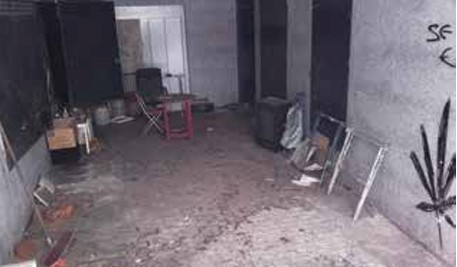
Current state of the cemetery excavation site at number 68 Toledo Street.
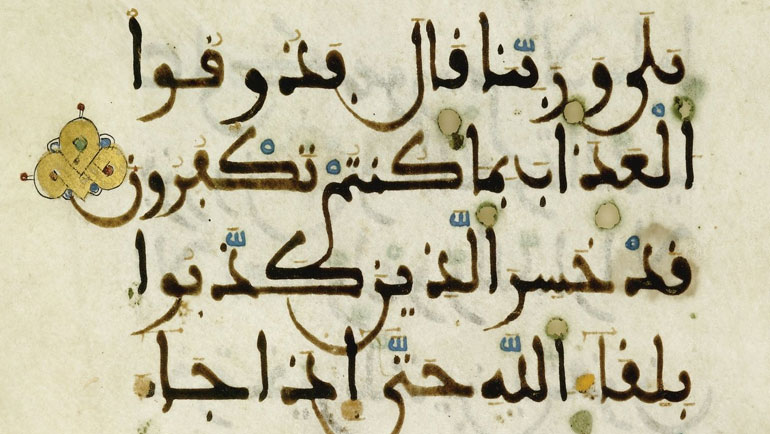
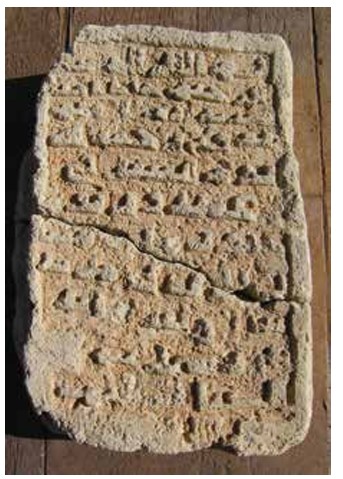
However, in many cases decorated stelae were used, some without inscriptions and others with epigraphic texts, and certain prominent individuals even had qubbas, or mausoleums. The stones from Muslim cemeteries, whether carved or not, were generally looted and reused in the construction of churches and other buildings. This likely occurred in Madrid after Alfonso VI’s conquest, and perhaps the Mudejars, upon converting, sought to prevent it from happening again when they requested the preservation of the ossuary “with its stones”. The only funerary stele known in Madrid—which represents one of only two surviving examples of Arabic epigraphy in the city, the other being a plaster alfiz—was recently rediscovered and studied. The circumstances of its discovery are unknown, though it apparently occurred around two decades ago during the demolition of a building in central Madrid, and for some reason it ended up in private hands, eventually being sold to the Regional Archaeological Museum. It is a rectangular limestone slab, approximately 41 × 26 cm, considerably deteriorated, with a raised inscription in Arabic characters of archaic Kufic style, typical of emiral epigraphy, and traces of red pigment that once highlighted the inscription. The study and translation of the stele were carried out by the Arabist María Antonia Martínez Núñez3, a specialist in Andalusi epigraphy.
In the name of God, the Most Compassionate, the Most Merciful. This is the tomb of Darir ibn Ibrahim. He died, may God have mercy on him, on Saturday during the day, twenty days after Ramadan, in the year three hundred and eight [20 Ramadan 308 / February 2, 921], and may God refresh his grave. Life is in the peace of God.
Nothing is known about this individual, whose name, Darir, is quite unusual, and whose patronymic “son of [ibn] Ibrahim” does not allow any conclusions about a specific family or ethnic origin. His age at death is also not indicated. What we do know, however, is that he was a person of some significance—not only because of the funerary stele itself, but also due to an irregularity on its back suggesting that it was originally set into the wall of a larger funerary structure. Furthermore, according to Professor Martínez Núñez, the features of the stele are typical of an urban epitaph, as stelae found in rural areas usually have different textual characteristics. All this suggests that by the end of the emirate, Madrid had already reached a certain level of urban development, which is entirely consistent with the designation of civitas used by Bishop Sampiro when narrating Ramiro II’s incursion in 936, and the analogous term madina employed by Ibn Hayyán in reference to the appointment of a governor in 940.
References
P. Porras Arboledas: «La documentación del derecho de propiedad y el delito de estelionato (Castilla, siglos XV-XVIII)», Cuadernos de Historia del Derecho, 2004, vol. Extraordinario, p. 270.
J. I. Murillo Fragüero: «Registro estratigráfico de una necrópolis musulmana en la calle Toledo. 68 (Madrid). El proceso de islamización a través del ritual del enterramiento», Actas de las terceras jornadas de Patrimonio arqueológico en la Comunidad de Madrid, Madrid: Comunidad de Madrid, Dirección General de Patrimonio Histórico, 2009, pp. 89-98.
Mª Antonia Martínez Núñez: «Estela funeraria de cronología omeya aparecida en Madrid (308/921)», Al-Qantara, XXXVI 1, 2015, pp. 141-163.
The information in this article has been taken from: Gil‑Benumeya, D. (2016). El cementerio musulmán de Madrid: la maqbara olvidada. Madrid histórico, (65), 35‑39.
Utilizamos cookies propias y de terceros para fines analíticos y para mostrarle publicidad personalizada en base a un perfil elaborado a partir de sus hábitos de navegación (por ejemplo, páginas visitadas).
Funcional
Always active
El almacenamiento o acceso técnico es estrictamente necesario para el propósito legítimo de permitir el uso de un servicio específico explícitamente solicitado por el abonado o usuario, o con el único propósito de llevar a cabo la transmisión de una comunicación a través de una red de comunicaciones electrónicas.
Preferencias
El almacenamiento o acceso técnico es necesario para la finalidad legítima de almacenar preferencias no solicitadas por el abonado o usuario.
Estadísticas
El almacenamiento o acceso técnico que es utilizado exclusivamente con fines estadísticos.El almacenamiento o acceso técnico que se utiliza exclusivamente con fines estadísticos anónimos. Sin un requerimiento, el cumplimiento voluntario por parte de tu Proveedor de servicios de Internet, o los registros adicionales de un tercero, la información almacenada o recuperada sólo para este propósito no se puede utilizar para identificarte.
Marketing
El almacenamiento o acceso técnico es necesario para crear perfiles de usuario para enviar publicidad, o para rastrear al usuario en una web o en varias web con fines de marketing similares.