

Articles
Archaeology in Castilla-La Mancha Progresses Hand in Hand with FUNCI

Aug
Article author: Center for Studies on Islamic Toledo
Date of publication of the article: 01/08/2025
Year of publication: 2025
Article theme: Al-Andalus, Archaeology, Castilla-La Mancha.
The Islamic Culture Foundation (FUNCI), via the Center for Studies on Islamic Toledo (CETI), collaborates in a large number of archaeological research projects related to the Andalusi world in the territory of Castilla-La Mancha.
The Center for Studies on Islamic Toledo (CETI), which belongs to the Islamic Culture Foundation (FUNCI), co-finances and collaborates in several projects that have been subsidized by the annual call for grants from the Junta de Comunidades de Castilla-La Mancha (JCCM) to carry out research on the archaeological and paleontological heritage of the region.
Three projects linked to FUNCI have received funding from this line of grants: the second phase of Patrimonio hidráulico y paisaje en las riberas del Tajo. Toledo visto a través de su río, carried out jointly with the University of Granada (UGR); El monasterio altomedieval de Santa María de Melque (Toledo). Configuración arquitectónica y usos, with the School of Arab Studies (EEA-CSIC); and Geoarqueología de la cantería histórica y la edilicia rupestre en el sudeste de La Alcarria with the Spanish Geological and Mining Institute (IGME-CSIC).
The execution of these works will be developed during the next months of the year 2025. Each of them includes different objectives, programmed activities and methodologies, but all of them, in one way or another, show an interest in a cultural heritage that is connected to the Andalusi legacy of Castilla-La Mancha.
Hydraulic heritage and landscapes on the banks of the Tagus. Toledo seen through its river
After a first year (2024) of progress in the study of the hydraulic heritage and cultural landscape associated with the Tagus River as it passes through the city of Toledo, the Biocultural Archaeology Laboratory of the University of Granada (MEMOLab) and the Center for Studies on Islamic Toledo will continue to advance this project. The large interdisciplinary team is headed by Professor José María Martín Civantos (UGR) and will apply advanced methodologies of landscape archaeology and geographic information technologies for the analysis and documentation of this Toledo heritage.

Several hydraulic structures in the surroundings of the Alcántara bridge (Toledo). The project proposes to continue with the identification, documentation and analysis of historical hydraulic structures, such as weirs, mills and hydroelectric plants. After having covered during 2024 the river course from the Huerta del Rey to the area of the San Martín bridge, this year the work area will be located between the tower of the Baño de la Cava and the old Buenavista power plant. On the other hand, a more detailed archaeological study of the Artificio de Juanelo and its surroundings will be undertaken.
The main objective of this proposal continues to be to characterize a cultural landscape that has been undergoing transformation from ancient times to the present day, with significant influences from Islamic culture, as well as to supplement the information contained in the heritage management tools developed in the previous phase. The scientific and social dissemination of the results through conferences, articles, and institutional collaborations is also planned.
The early medieval monastery of Santa María de Melque (Toledo). Architectural layout and uses
This project, which has been running for several years under the auspices of the Junta de Comunidades de Castila-La Mancha, aims to further our understanding of the monastic complex of Santa María de Melque (San Martín de Montalbán, Toledo), one of the most important early medieval sites in the Iberian Peninsula and Western Europe. This site is crucial to understanding the history of al-Andalus, as studies indicate that it is a Christian complex created and developed during the centuries of Islamic political domination in the territory. The research will be led by María de los Ángeles Utrero Agudo, from the School of Arab Studies (EAA, CSIC).

Aerial view of the church of Santa María de Melque
During 2025, research will focus on Zone II of the monastery, with special attention to the north nave and its relationship with the upper enclosure (Zone I), in order to understand its architectural configuration, functionality, and historical evolution. The activities include archaeological excavations, archaeobotanical and archaeozoological analyses, geological and materials studies, as well as scientific dissemination activities.
The interdisciplinary approach, combining archaeology, geology, and technology, will enable an innovative and rigorous approach to the region’s cultural heritage.
Specific objectives include: documenting the structure and evolution of the north nave, characterizing the construction and decorative materials, analyzing botanical and faunal remains to reconstruct the diet and agricultural and livestock practices of the monastic community, and studying the ceramics through archaeometric analysis.
The project also includes the preparation of technical reports and academic publications and the opening of the site to the public during the excavation campaigns.
Geoarchaeology of historic stonework and rock architecture in southeastern Alcarria
This project aims to conduct a comprehensive study of historic quarries and rock-cut buildings—architecture or constructions carved directly into the rock—in the southeast of the La Alcarria region. This type of heritage, which is often overlooked or poorly documented, is particularly relevant for understanding the buildings of the past. Behind every piece of architecture there was a construction project that began in the quarry and ended in the building. Research has traditionally focused on the construction site—its execution or architecture—thereby neglecting a series of essential actions: the search for and extraction of stone and its transport. Archaeology can offer perspectives for approaching the traces of these activities in the landscape, which reflect the socioeconomic and technical aspects of the people who inhabited these places. The principal investigators for this project are Enrique Álvarez Areces, from the Geological and Mining Institute of Spain (IGME-CSIC), and Sergio Isabel Ludeña, scientific coordinator of the Center for Studies on Islamic Toledo (CETI-FUNCI).
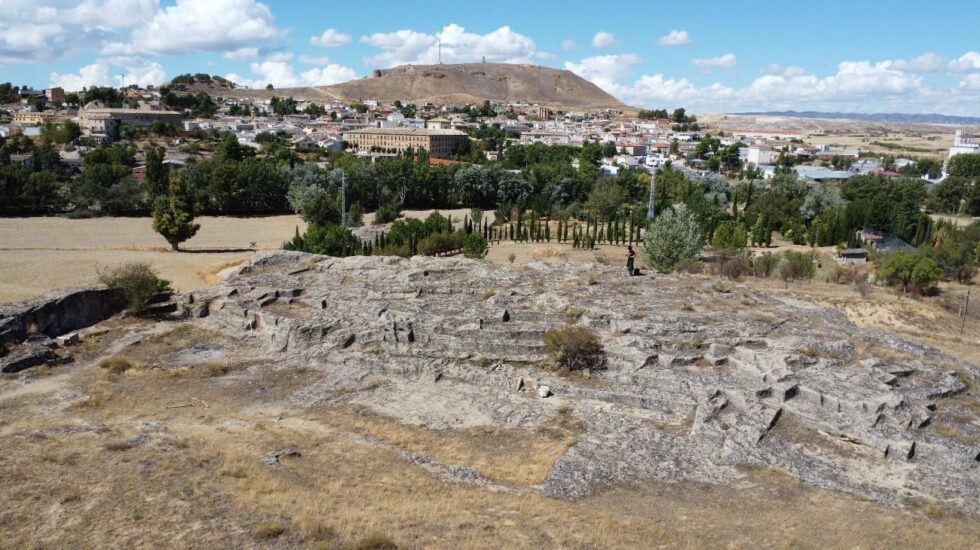
Aerial view of a sandstone quarry with the municipality of Huete in the background.
During the months of this research, we will seek to advance the identification, documentation, and analysis of these quarry sites and the rock art found within them. Beyond the importance of stone quarrying in Roman times, it is essential to highlight that the techniques and methods of stone extraction from Antiquity were revived during the Andalusi period. This was made possible by the promotion of large architectural projects by the Umayyad state—with the resurgence of urban centers and the restoration of the idea of prestige and power associated with stone—as well as the existence of Islamic stonemasons with the necessary knowledge to carry them out.
The specific objectives of this project include: the location of new quarries, the characterization of carved rock elements inside them, the geological analysis of stone materials, the definition of exploitation systems and chronologies, and the assessment of the impact of climate change on underwater elements.
The activities include archaeological surveys, drone flights, petrographic analyses, cataloguing, stratigraphic studies in selected quarries, and assessment of deterioration in areas flooded by reservoirs. The interdisciplinary approach, combining archaeology, geology, and technology, will enable an innovative and rigorous approach to the region’s cultural heritage.
Este artículo está disponible en Español.