


Articles
Afghan Carpets at Madrid’s Rastro
Oct
Traditional Afghan carpets are now filling Madrid’s Rastro flea market, connecting 250 families from Surkh Aqcha with Spanish buyers. The business adapts ancestral weaving traditions to modern tastes, transforming livelihoods and interiors across continents.
From Afghanistan to Madrid’s Rastro
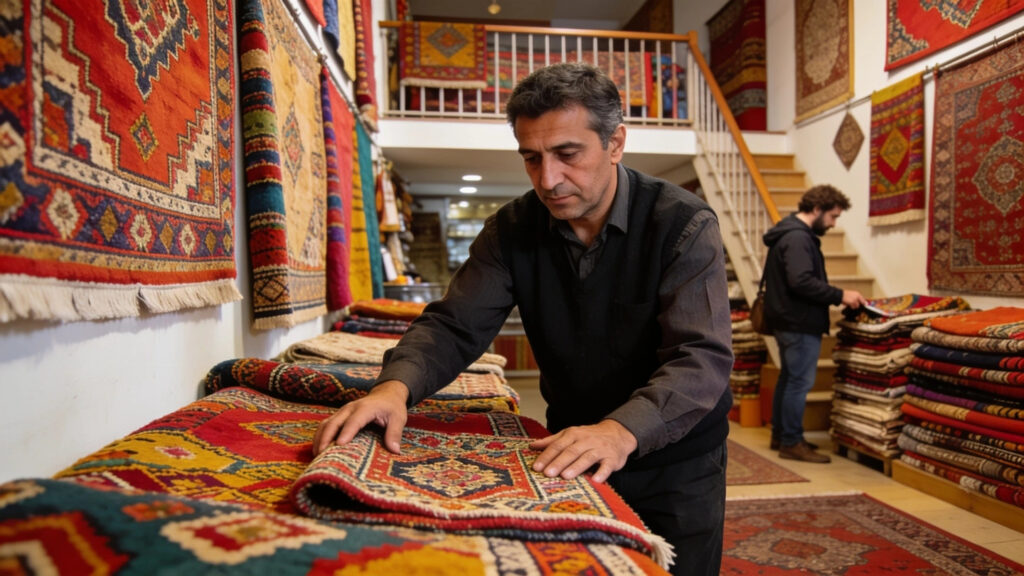
Carpets woven in the Afghan village of Surkh Aqcha now cover the floors and walls of Madrid’s Rastro, having crossed continents and decades of turmoil along the way. What began as a means of survival for families displaced by war has become a stable source of income for nearly 250 households, thanks to one trader’s efforts to connect two distant worlds.
His business goes beyond selling carpets: it supports an entire community in his country of origin, where weaving is often the only way to make a living.
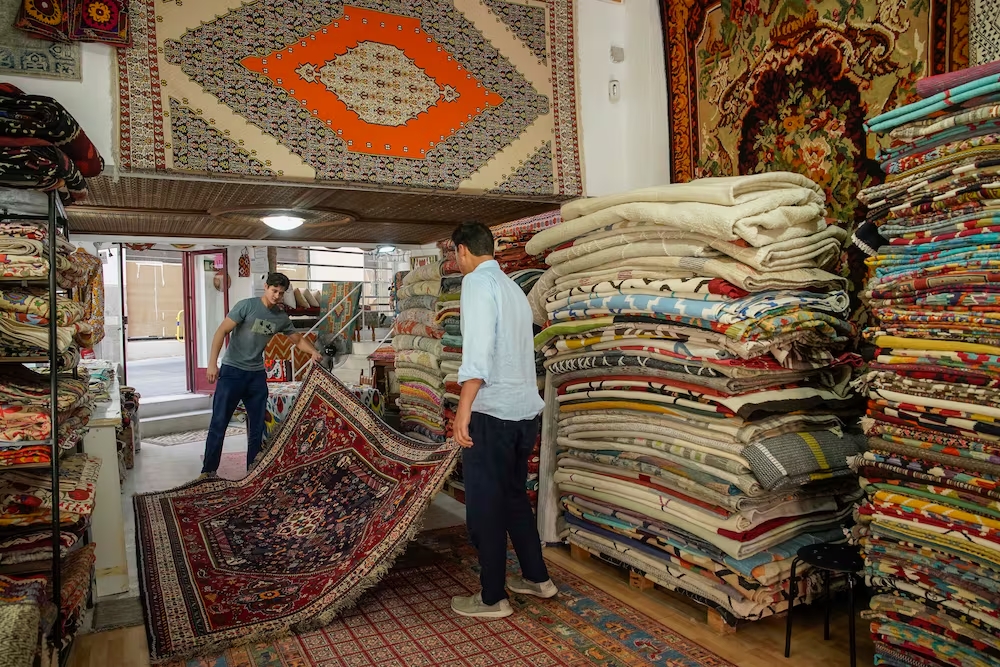
Abdul Hakeem arrived in Spain barely speaking Spanish and with no contacts. Today, he runs Tailak, a two-storey shop where traditional Afghan motifs coexist with bold, custom-made designs. His business goes beyond selling carpets: it supports an entire community in his country of origin, where weaving is often the only way to make a living. Afghan women earn $80 per square metre woven. Men handle the washing and dyeing, earning between $100 and $300 a month. The shop’s shelves, packed with intricate textiles, are the visible end of a supply chain that begins in family courtyards and home workshops thousands of kilometres away.
A Tradition Adapted to the Spanish Market
Demand in Madrid has transformed the craft itself. While classic Oriental motifs remain, around 60% of Tailak’s carpets are now made to order, tailored to Spanish tastes and requests from film set designers. Some pieces have appeared in Pedro Almodóvar’s The Room Next Door and Julieta, as well as in the upcoming miniseries The Final Problem. The journey from Surkh Aqcha to Madrid is complicated: the carpets travel by road to Kabul, then by air to Dubai or Istanbul, and finally to Spain. Each order can take up to three months, with prices ranging from €120 to €300 per square metre.
Hakeem’s journey has not been easy. Forced to flee Afghanistan during the Soviet invasion, his family spent years in a Pakistani refugee camp before returning to their village, where weaving was a necessity. When Hakeem moved to Spain in 2008, his first attempt to sell carpets in Barcelona failed. It was not until he moved to Madrid’s Rastro in 2009 that he found support from local traders, who sent customers his way and helped him get established. Today, Tailak has a second location in Chueca and works with a growing network of designers and interior decorators.
A Supply Chain Supporting 250 Families
The business is built around locally sourced Afghan wool, traditional looms and a division of labour: women weave, while men handle the processing. The Surkh Aqcha workshop, opened in 2013, currently employs around 50 men in washing and dyeing, while nearly a quarter of the village’s families are involved in weaving. Hakeem estimates that 70% of his stock comes from Surkh Aqcha, with the remainder sourced from other regions.
For the families involved, there is a great deal at stake. Sakhi Haji, a veteran of the Surkh Aqcha workshop, says that greater investment could transform the region, where skilled artisans often struggle to find stable work. The contrast with other migrant labour stories is striking: while some foreign workers in Spain face exploitation and poor working conditions—as previously reported—the Tailak model sends profits directly to Afghan households, offering a rare example of ethical cross-border trade.
Craftsmanship Crossing Borders
Madrid’s interest in Afghan carpets goes beyond a matter of taste. It demonstrates how migration, entrepreneurship and cultural adaptation can reshape both economies and identities. Hakeem’s success is rooted in hard work and community ties, not charity or nostalgia. His carpets now decorate Spanish homes, businesses and film sets—a sign that traditional craftsmanship can survive and even thrive far from its origins. In a market often dominated by mass production and middlemen, Tailak’s approach stands out for its transparency and direct impact.
Website: Taliak.es
Instagram: @tailak_madrid | @tailak_chueca1
Source: Russpain
Cover image: Afghan Carpets Transform Madrid’s Rastro and Support 250 Families ©Russpain
Este artículo está disponible en español.