


Articles
From embroidered textile to the spinner´s work. A new reading of the textile production in al-Andalus (9th-13th Centuries)
May
Article author: José María Moreno Narganes
Date of publication of the article: 28/05/2026
Year of publication: 2026
Article theme: Al-Andalus, Archaeology, Archaeology, Arqueología.
The Andalusi textile was not only the exceptional scope of Caliphal silks, cloths with gold threads or luxury items associated with power. It was, above all, an everyday practice that united agriculture, livestock farming, domestic work, taxation, market and consumption. The recent investigation crystallized in Trabajando en casa: producción de hilo y tejido en el espacio doméstico de al-Andalus (ss. IX–XIII), published by the University of Jaén, allows that world to be seen from the archaeological record, encompassing over one hundred sites, extended across the territory from the Portuguese coast of Garb al-Andalus to the Mediterranean coast of the Sharq. Spinning tools such as whorls, spindles, and distaff elements, weaving equipment like vertical and horizontal looms, and countless other tools such as needles, thimbles, combs and scissors have been analyzed, with all this material scattered throughout houses in alquerías, fortified settlements, urban arrabales, and even alcazabas.The result is a less glamorous, but historically far more fertile image: that of textiles as one of the essential economic activities of al-Andalus, strongly supported by female and family labor, structured through commercial networks, and subject to the rhythms of a tributary state that, between the 9th and 13th centuries, fostered a profound technical and material reconfiguration of tools and the organization of work.
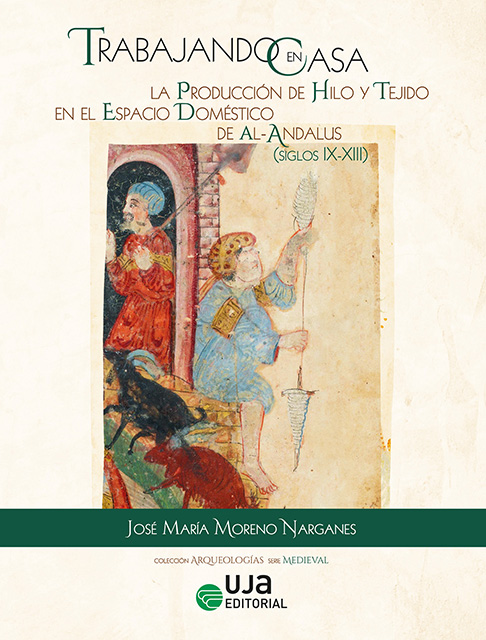
Fig. 1. Cover of the book Trabajando en casa: producción de hilo y tejido en el espacio doméstico de al-Andalus (ss. IX–XIII) (Author)
When we think of Andalusi textiles, what usually comes to mind are rich fabrics, a fragment of ṭirāz, a silk with a Kufic inscription, or an altar cloth preserved in an ecclesiastical treasury. However, as Laura Rodríguez Peinado has pointed out, textile production was a primary economic, social, and cultural factor, visible in historical sources, preserved fabrics, and, increasingly, in archaeology. And, as Eva Andersson points out, textiles and their use respond both to material needs and to shaping a complex social language: they provide information about hierarchies, socio-economic class, identities, gender, religion, or community belonging. In this sense, textile lies at the intersection of the economic, the technical, and the symbolic fields, acting simultaneously as a product, a process, and a medium of expression.
Applied to al-Andalus, this perspective makes it possible to shift the focus from the luxury item to the entire labor chain. The significance of the monograph published by the University of Jaén lies in this change of scale. The volume index is a methodological proposal that combines the archaeology of domestic space, the archaeology of production, a materialist perspective on state and tribute, the study of plant and animal raw materials, the diachronic analysis of tools, and a morphometric appendix that seeks to measure, compare, and establish typologies. It involves moving from the particular—the tool found inside the home—to reconstructing the working systems that explain its origin, evolution, and obsolescence.Therefore, the decisive question is no longer which fabrics the court admired, but rather how, where, with what tools, and under what social relations wool, linen, hemp, cotton, or silk were transformed into threads, cloths, and garments.
Textile production was part of the economic foundation of a complex and diverse market, capable of supplying local circuits and connecting with broader scales of exchange.
As Manuela Marín has shown, clothing and textiles in al-Andalus can be read through legal documents, urban practices, and forms of identity, especially those linked to the elites. The articulation of these sources with regulations, agronomy, archaeobotanics, archaeozoology, and the material record now allows for the construction of a denser and socially more complex historical narrative. In this narrative, textiles appear as an evolving technology—a practice requiring technical knowledge, time, skill, and a sustained investment of labor. From this perspective, textile production was part of the economic foundation of a complex and diverse market, capable of supplying local circuits and connecting with broader scales of exchange, taxation, and consumption. This productive infrastructure relied, to a large extent, on a domestic and familial organization of labor, sustained by a predominantly female effort distributed across the life cycle. From childhood learning to the experience accumulated in old age, spinning, weaving, and their associated tasks were inscribed within the daily shadow of the household, patriarchy, and the tributary state.
Andalusi textile depended on specific agrarian and pastoral landscapes, as reflected in the botanical and agronomic sources studied by Expiración García Sánchez. These sources demonstrate the importance of textile and dye plants in the industrial activity of the Islamic world and, particularly, of al-Andalus. Among the plant fibers, linen and hemp stand out, alongside cotton, whose introduction and expansion were part of the agrarian transformations associated with the Islamic conquest and the so-called ‘Green Revolution.’ Indeed, a recent assessment of the issue insists that the increase in agricultural productivity and the reorganization of productive spaces between the tenth and twelfth centuries were decisive for the economic transformation of the territories of al-Andalus.
Wool, for its part, points to a developed livestock base. As exemplified by the archaeozoological studies compiled by Marcos García García and Marta Moreno García, there is an overrepresentation of oviscaprids in many Andalusi assemblages, both urban and rural. This indicates not only a specific diet and meat exploitation, but also a parallel structural availability of wool and bone—two essential raw materials for the textile chain. This conclusion dialogues well with the monograph’s observations regarding the presence of worked bone tools and the relationship between livestock intensification and textile implements.
Silk was not a luxury product detached from its material base, but rather the result of a chain of labor that began in the rural environment.
Silk indeed occupies a unique place within the Andalusi textile universe. The Calendario de Córdoba, compiled in 961, allows us to follow the annual rhythm of this activity with remarkable precision, as it links both the agricultural tasks related to mulberry cultivation and the various stages of fiber extraction and management. This reveals the extent to which sericulture was part of a complex and perfectly scheduled economic organization. Within this same productive cycle, a highly significant social distribution of labor is also perceptible: during the month of February, for example, it was women who gathered the silkworm eggs and began their incubation, thus tending to one of the most delicate phases of the process. At other times of the year, the fiscal administration intervened, sending orders to provincial agents to requisition silk destined for the ṭirāz, or palatine workshop. The documentation therefore allows us to understand that silk was not a luxury product detached from its material base, but rather the result of a chain of labor that began in the rural environment, relied partly on female labor, and culminated in mechanisms of control, redistribution, and consumption linked to the court. Rather than a marginal or incidental sector, sericulture acted as a true point of articulation between the agrarian landscape, productive specialization, taxation, and luxury manufacturing in al-Andalus.
This division is essential when considering the logic of the chaîne opératoire, since the technical knowledge—and with it, the tools involved—varied substantially depending on the fiber, even though the general framework can be reconstructed. For wool: shearing, washing, scouring, drying, carding or combing, spinning, twisting, warping, weaving, and finishing; for linen and hemp: harvesting or pulling, drying, retting, breaking, scutching, hackling, spinning, and weaving; for cotton: cleaning, ginning, bowing, spinning, and weaving; for silk: sericulture (or silkworm rearing), cocoon harvesting, reeling, twisting, dyeing, and weaving.
Each piece embodies a concrete technical solution, linked to a specific raw material and a precise production phase, thus allowing for the reconstruction of the chaîne opératoire.
However, what is truly historical is both the sequence itself and the fact that each of these processes implied specific technical knowledge, differentiated bodily gestures, and distinct labor times, all of which materialized in an equally diverse set of tools. The study of these implements—such as spindle whorls, spindles, distaff elements, templets, weaving picks, combs, shears, and winding or twisting components—is fundamental. Each piece embodies a concrete technical solution, linked to a specific raw material and a precise production phase, thus allowing for the reconstruction of the chaîne opératoire, the specialization of labor, and its transformations over time. In this sense, textile archaeology is not limited to compensating for the absence of the finished product—rarely preserved due to its organic nature—but more consequentially opens a privileged pathway to analyze the circulation of technical knowledge on a Mediterranean scale. This is visible in the adoption, adaptation, and persistence of forms, materials (ceramics, bone, metal), and working systems that connect local contexts with broader dynamics of technological transmission.
Tools, Gestures, and Technical Changes
The most ubiquitous spinning tool is the spindle whorl, the counterweight that provides inertia to the spindle and regulates the twist. Its mass, diameter, perforation, and material are crucial; as technical analyses demonstrate, the size of the spindle and the whorl directly correlates with the characteristics of the thread to be produced. The monograph has shown that, from the ninth century onward, Andalusi spindle whorls tended to move away from cruder solutions in bone or reused ceramics toward molded ceramic pieces with greater morphometric uniformity—a clear sign of technical standardization. In the twelfth and thirteenth centuries, the presence of bone specimens also increased; being lighter, these were suited for finer spinning, while spindle tips and distaff elements simultaneously multiplied in the archaeological record. The spindle was the axis of this labor—a rod that, through rotation, converted loose fiber into continuous thread. The distaff, understood in the broad sense with which it appears in the Andalusi archaeological record, refers to a set of components linked to supporting, preparing, and controlling the fiber during spinning. In this context, the so-called ‘distaff elements’—known as distaff towers—acquire special relevance. Generally crafted from bone, these pieces transcended their strictly functional dimension. Despite their utilitarian purpose, many of them exhibit careful formal craftsmanship and elaborate decoration, pointing to a social and symbolic dimension of textile labor. They are not merely tools; they are objects embedded in daily practices laden with meaning, where technique, aesthetics, and identity intertwine. Their decoration, far from being incidental, suggests that the act of spinning also involved forms of representation, prestige, or even cultural affirmation, thereby revealing the social depth of an apparently commonplace activity.
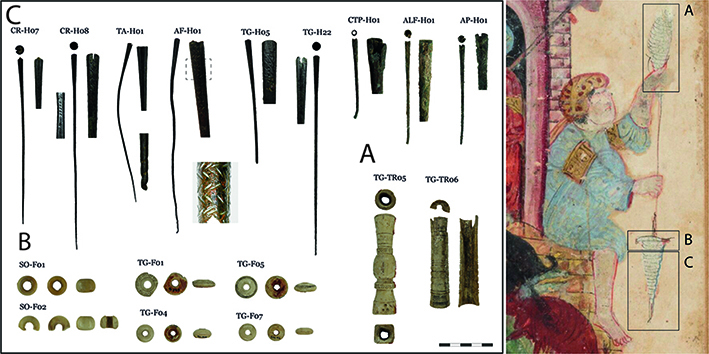
Figure 2. Spinning through the archaeological record of various sites in al-Andalus (Left) and the Maqāmāt of al-Ḥarīrī (Right). A: Distaff elements. B: Spindle whorls. C: Copper-alloy spindle tips.
In the case of weaving, the predominant narrative has been constructed around the templet and the expansion of the horizontal treadle loom in al-Andalus. However, this reading has tended to simplify the productive complexity of the record by projecting an overly linear image of technical change. Faced with this, the available evidence invites us to think of a more dynamic process, in which different forms of labor, tools, production spaces, and rates of technological adoption could coexist, overlap, and transform unevenly according to social, territorial, and domestic contexts. The published study has provided a glimpse that the arrival and dissemination of the horizontal treadle loom became visible in al-Andalus from the late ninth century onward; at the same time, evidence suggests that the vertical frame loom did not immediately disappear in places like Córdoba and Toledo, meaning that innovation and continuity coexisted for a time. This coexistence is one of the most interesting features of technical change: new systems do not automatically erase old ones; rather, they overlap with them, adapting to different fibers and needs. In addition to these pieces, the record includes needles, thimbles, comb teeth, and shears. None of these, on its own, creates a workshop; together, however, they map out work environments or scenarios. Andalusi textile archaeology rests precisely on this sum of evidence: objects of bone, ceramics, or metal, found in domestic rooms, refuse heaps, rural hamlets, suburbs, or urban sectors, which allow for the identification of fiber preparation, spinning, weaving, sewing, repair, and finishing tasks. As has been emphasized out of methodological necessity, interpretation must descend to the specific stratum and room when the excavation permits. It is there that the ‘house’ ceases to be an architectural backdrop and becomes a place of production.
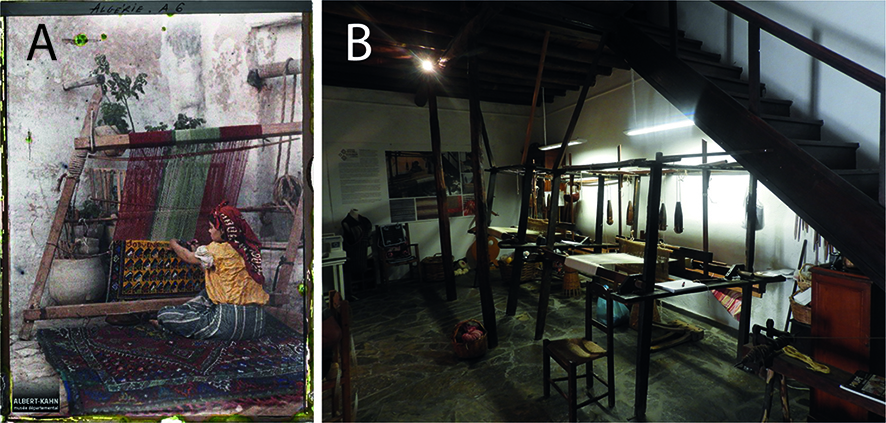
Figure 3.Contemporary examples of looms in al-Andalus. Heritage and technique of the vertical frame loom (A) and the horizontal treadle loom (B). Left: Archives de la Planète – Albert Kahn Collection. Right: Author.
Houses, workshops and markets
The central contribution of the monograph “Trabajando en Casa” lies in restoring centrality to the domestic space, no longer as a secondary backdrop, but now as a true decentralized workshop integrated into the economy. Within it, and now materialized through textile production, the patriarchal family was the essential productive cell in a precapitalist economy, and the interior of the home—its rooms, courtyards, thresholds, and annexes—must also be understood as a workspace.
These activities within the walls of the house did not signify isolation. In this sense, as Alejandro García Sanjuán has shown when studying the ḥisba manuals , Andalusi crafts were organized and subjected to state control through the muḥtasib and delegates or alamines ; this organization seems to have consolidated more clearly during the twelfth and thirteenth centuries. The market was not a ‘free’ arena in the modern sense; it was a regulated, monitored space crisscrossed by mediators. The textile sector, due to its scale and the importance of prices, qualities, and frauds, fits well within this logic of supervision. At the same time, domestic textiles cannot be understood apart from taxation. One of the most suggestive hypotheses presented for textile production is understanding the effect of the Andalusi state’s fiscal pressure which, going beyond simple artisanal ‘promotion,’ may have driven improvements in tools, work rhythms, and productive capacity. In this way, the argument ceases to start from the elite and places those who materially sustained production at the forefront. Fiscal extraction generated the monetary engine that made possible both the wage-earning specialization of the ṭirāz and the development of a high value-added textile sector. The surplus value captured through taxes funded mosques, palaces, fortresses, and armies; but it also, indirectly, demanded a productive base capable of sustaining it. Everyday textiles and courtly silk were not two isolated economies: they were part of the same fiscal and mercantile universe.
Everyday textiles and courtly silk were not two isolated economies: they were part of the same fiscal and mercantile universe.
Inquiring into who produces and what role they play in each phase of the process necessarily leads to addressing the question of gender—that is, the technical and social division of labor underlying textile production. Historical and archaeological research concurs in pointing out that activities such as spinning, silk reeling, or fiber preparation were persistently linked to female labor, both within the domestic sphere and in certain contexts of more concentrated production. This association is supported by a heterogeneous body of sources: regulatory texts such as fatwās, which indirectly elude to these activities in legal contexts; ḥisba treatises, where crafts, qualities, and commercial practices are regulated; geographical works such as those by al-Idrīsī, which describe production centers and regional specializations; or travelogues (riḥla), which provide observations on labor, markets, and daily practices across different territories of the Islamic world. To this must be added agronomic and calendar sources—such as the Calendario de Córdoba—which allow these activities to be inserted into annual productive cycles. Taken together, this constitutes a fragmentary and often indirect corpus that demands a critical reading, yet consistently points to the centrality of this labor.
However, assuming this link does not imply simply accepting the traditional division between ‘domestic labor’ and ‘specialized labor.’ The material record itself—consisting of increasingly complex tools, the diversity of raw materials involved, and technical precision—evidences that each phase of the process represents highly skilled practices. Mastering spinning, controlling the twist, properly preparing fibers, or managing spindle whorls alongside the rhythms and patterns of weaving picks required prolonged apprenticeship, specific skills, and a constant transmission of technical knowledge. Furthermore, this involves dynamic know-how, connected to processes of innovation and technological circulation on a Mediterranean scale, where forms, materials, and technical solutions were adapted and transformed according to local contexts. In this sense, speaking of ‘domestic production’ should not imply a depoliticization of the issue, nor its reduction to the private sphere. On the contrary, it means recognizing that a substantial part of the Andalusi economy was sustained by continuous, skilled, and socially structured labor, largely carried out by women, whose contribution was fundamental both for daily reproduction and for the articulation of broader productive, commercial, and fiscal networks. The combination of written sources—legal, geographical, narrative—and archaeological evidence thus allows us to reconstruct a reality in which the domestic space reveals itself as a key arena for production, innovation, and the transmission of technical knowledge.
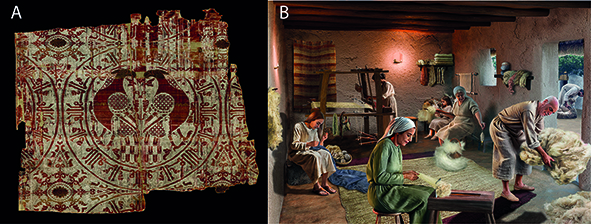
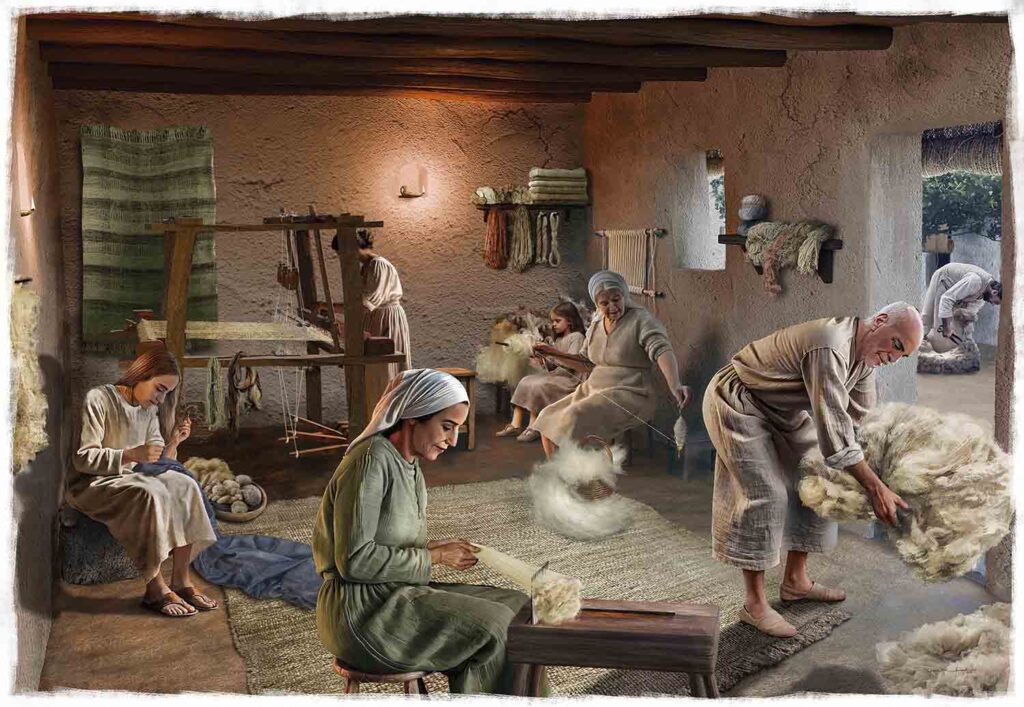
Figure 4. From the caliph’s textile to the house. A: Andalusí textile of las Águilas (Ramos 2022, 534). B: Domestic textile production. (Illustrated by Giuseppe Berardi. Asesoría: Joan Negre, José María Moreno Narganes y Marcos García. Museu Arqueològic de Gandia. Ceded.).
Eneko López‘s research has highlighted that textile production in al-Andalus was organized around a remarkable diversity of centers and scales, whose articulation can only be fully understood if the role of the ṭirāz is integrated as a political, economic, and technical device. Far from constituting a dual system between state workshops and dispersed production, the Andalusi landscape reveals a hierarchical structure in which palatial workshops, specialized urban manufactures, and a widely extended domestic base coexisted—and interacted.
At the apex of the system was the Umayyad ṭirāz , institutionalized from Cordoba as part of the state apparatus and closely linked to the legitimization of power. From the Emirate period, and especially following the reforms of ‘Abd al-Raḥmān II, a network of workshops coordinated by the administration was articulated, with a central core in the dār al-ṭirāz and a defined internal hierarchy. At its upper level stood out the ṭirāz khāṣṣ, the sovereign’s personal workshop, specialized in pieces intended for the caliph and his entourage—silks with metallic threads, embroideries, or imported textiles finished locally—whose value was both productive and symbolic, functioning as a marker of political proximity. Alongside this core, there existed a distributed network of state workshops that supplied the administration and the army with diverse productions—ranging from high-quality silks ( khāṣṣ) to linen, felts, or mixed textiles—in volumes capable of sustaining military campaigns and redistributive practices. This system can only be explained by the coordination of multiple productive units, including both state structures and private workshops working under contract or in connection with the ṭirāz, shaping a hybrid, not fully centralized model based on control and redistribution. At an intermediate level, urban workshops—such as those in the Cordoban souk—acted as spaces for transformation, specialization, and circulation. In them, different fibers, techniques, and qualities were worked in relation to both state demand and urban markets, functioning as nodes that connected domestic production with commercial circuits and, occasionally, with the ṭirāz itself. However, the base of the system resided in an extensive domestic production, documented in all types of settlements, which guaranteed local supply and the generation of surpluses. In certain contexts, a segmentation of the operational chain is even perceived, with households specializing in specific phases, pointing to forms of distributed specialization without concentration in large workshops.
This system can only be explained by the coordination of multiple productive units, including both state structures and private workshops.
At a territorial scale, this structure was reflected in the emergence of specialized regional centers, initially integrated into the logic of the ṭirāz but progressively oriented toward the market. Examples such as Zaragoza, with its marten-fur coats, or Baza, with its dībāj carpets, evidence productions linked to local resources and traditions that eventually consolidated thanks to private demand. This process culminates in the southeast, along the Pechina–Almería axis, where since the late 9th century private workshops connected to maritime networks channeled raw materials and products into long-distance circuits. Following the crisis of the caliphate in the 11th century and the disappearance of the ṭirāz, these centers transformed into hegemonic poles of Mediterranean textile production, as demonstrated by the expansion of Almeria’s silk workshops.
From a diachronic perspective, the Andalusi textile system thus undergoes an evolution; between the 9th and 10th centuries, a logic of centralization and state control predominates, in which the ṭirāz acts as the organizing axis of production and as an instrument of social hierarchy. From the 11th century onward, however, a progressive regional diversification is observed, alongside greater autonomy for urban and private workshops, and an increasing integration into commercial networks, where the market takes on an ever-greater role. This implied its rearticulation within a more complex system, in which different productive scales—such as domestic, urban, and state—respond to differentiated levels of consumption, ranging from the daily to the luxury. The ṭirāz, urban workshops, and domestic production formed part of the same multiscalar productive structure, in which technical differentiation, social hierarchy, and territorial articulation combined to give rise to a highly flexible economic model, capable of adapting both to the demands of power and to the changing dynamics of the market.
From Andalusi textiles to the spinner:
The greatest virtue of this line of research does not lie in offering a closed or definitive image, but rather in having opened a field that for too long remained subordinate to the historical narrative of luxury textiles. This work forces a change in scale and sensitivity: to look less at the exceptional cloth and more at the hours of labor that made it possible; less at the object as a treasure and more at the daily accumulation of gestures, learning, and hardships that sustained textile production in houses, courtyards, and workshops. Seen this way, Andalusi textiles cease to be just a chapter of the sumptuous arts to become a privileged avenue of access to the material reproduction of society, where women’s labor turns out to be central. Not only because spinning, preparing the fiber, winding, twisting, or sewing it were activities persistently associated with female work, but more rationally, because a very considerable part of that labor was absorbed within the household, naturalized as a family obligation and scarcely recognized as skilled production. However, it was precisely that mass of time, skill, and discipline that sustained a large part of the system.
The splendor of elite manufactures was only possible because it rested upon a much broader base of invisible labor.
It not only made possible the silk that fed courtly prestige or the ṭirāz sector; it sustained, above all, the daily clothing in towns and cities, the coarse or fine cloths for local consumption, the textile needs of broad layers of the population and, with it, the daily reproduction of the working classes. Quantitatively, and as Chris Wickham has recently argued, this was undoubtedly the main horizon of Andalusi textiles: not that of exceptional pieces destined for privileged minorities, but rather that of a dense, continuous, and socially extended local and regional consumption, which required an equally constant production. For this reason, it is worth emphasizing a final idea: the splendor of elite manufactures was only possible because it rested upon a much broader base of invisible labor. Beneath the cloths of gold, the caliphal silks, or the brocades celebrated by the sources, there was a demanding domestic economy, long days of fiber preparation, technical learning passed down between generations, and a diffuse but structural exploitation of female and family labor. Recognizing this does not diminish the importance of Andalusi textiles; on the contrary, it places it in its true historical dimension. It forces us to understand that one of the great productive forces of al-Andalus lay in the silent sum of thousands of hours of work carried out in the domestic sphere to clothe, shelter, and sustain the daily life of the majority.
Bibliography:
ANDERSSON STRAND, Eva, FREI, Karin M., GLEBA, Margarita, MANNERING, Ulla, NOSCH, Marie-Louise y SKALS, Irene (2010): «Old Textiles — New Possibilities», European Journal of Archaeology, 13/2, pp. 149–173.
‘ARĪB IBN SA‘D / DOZY, Reinhart, ed.; PELLAT, Charles, ed. (1961): Le Calendrier de Cordoue publié par R. Dozy. Nouvelle édition accompagnée d’une traduction française annotée, Leiden, Brill.
GARCÍA GARCÍA, Marcos y MORENO-GARCÍA, Marta (2018): «De huertas y rebaños: reflexiones históricas y ecológicas sobre el papel de la ganadería en al-Ándalus y aportaciones arqueozoológicas para su estudio», Historia Agraria, 76, pp. 7–48.
GARCÍA SÁNCHEZ, Expiración (2001): «Las plantas textiles y tintóreas en al-Andalus», en MARÍN, Manuela (ed.), Tejer y vestir: de la Antigüedad al Islam, Madrid, Consejo Superior de Investigaciones Científicas, pp. 417–452.
GARCÍA SANJUÁN, Alejandro (2023): «Sectores artesanos y su regulación en los manuales andalusíes de ḥisba (s. X–XIII)», en FÁBREGAS GARCÍA, Adela y GARCÍA PORRAS, Alberto (coords.), Artesanía e industria en al-Andalus: actividades, espacios y organización, Granada, Comares, pp. 3–20.
LÓPEZ MARTÍNEZ DE MARIGORTA, Eneko (2023): «El ṭirāz omeya de al-Andalus. De la jerarquización social, la centralización y la hegemonía estatal a la diversificación, la especialización regional y el dominio del mercado», en FÁBREGAS GARCÍA, Adela y GARCÍA PORRAS, Alberto (eds.), Artesanía e industria en al-Andalus: actividades, espacios y organización, Granada, Comares, pp. 21–50.
LÓPEZ MARTÍNEZ DE MARIGORTA, Eneko (2020): Mercaderes, artesanos y ulemas. Las ciudades de las coras de Ilbīra y Pechina en época omeya, Jaén, Editorial Universidad de Jaén.
MARÍN, Manuela (ed.) (2001): Tejer y vestir: de la Antigüedad al Islam, Madrid, Consejo Superior de Investigaciones Científicas.
MORENO NARGANES, José María (2025): Trabajando en casa: la producción de hilo y tejido en el espacio doméstico de al-Andalus (ss. IX–XIII), Jaén, UJA Editorial.
MORENO NARGANES, José María (2025): «Trama y urdiembre: una aproximación a la producción de hilo y tejido en al-Andalus (ss. IX–XIII)», Medievalista, 38, pp. 365–380.
RODRÍGUEZ PEINADO, Laura (2012): «La producción textil en al-Andalus: origen y desarrollo», Anales de Historia del Arte, 22, número especial II, pp. 265–279.
WICKHAM, Chris (2023): The Donkey and the Boat: Reinterpreting the Mediterranean Economy, 950–1180, Oxford, Oxford University Press.
© Cover image: Domestic textile production (Illustrated by Giuseppe Berardi. Asesoría Joan Negre, José María Moreno Narganes y Marcos García. Museu Arqueològic de Gandia. Cedida)